
New to importing and exporting?
Or already a regular importer/exporter… but still don’t fully understand the process behind it?
Whether it’s your first or hundredth shipment, logistics processes and terminologies can still be confusing, especially with frequently changing rules and regulations.
One of the key terminologies widely misunderstood in the industry are the SHIPPING INCOTERMS.
What Are Incoterms?
Incoterms (International Commercial Terms) are standardized trade rules created by the International Chamber of Commerce that define the financial, operational, and legal responsibilities of of Buyers and Sellers in international trade transactions.
Incoterms determine:
- Who arranges freight
- Who pays shipping costs
- Who handles export and import customs clearance
- Who assumes cargo risk during transit
- Where responsibility transfers from seller to buyer
These terms are recognized worldwide and are commonly used in:
- Commercial invoices
- Purchase orders
- Sales contracts
- Letters of credit
- Other important shipping documents
The latest version currently in use is Incoterms® 2020 (See below).
Why Incoterms Matter in International Shipping
Many shipment disputes happen because Buyers and Sellers assume different responsibilities.
Without clear Incoterms:
- Importers may unexpectedly pay customs duties or local charges
- Cargo insurance gaps may occur
- Delays at ports can happen due to unclear documentation responsibilities
- Freight costs may become higher than expected
For Philippine importers and exporters, understanding Incoterms helps:
- Prevent hidden logistics costs
- Improve shipment planning
- Reduce customs clearance issues and delays
- Clarify accountability between parties
- Optimize freight forwarding strategies
Shipping Incoterms: Buyer vs. Seller
The Buyer, also known as the Consignee, is the Importer of the goods.
Meanwhile, the Seller, also known as the Shipper, is the Exporter of the goods.
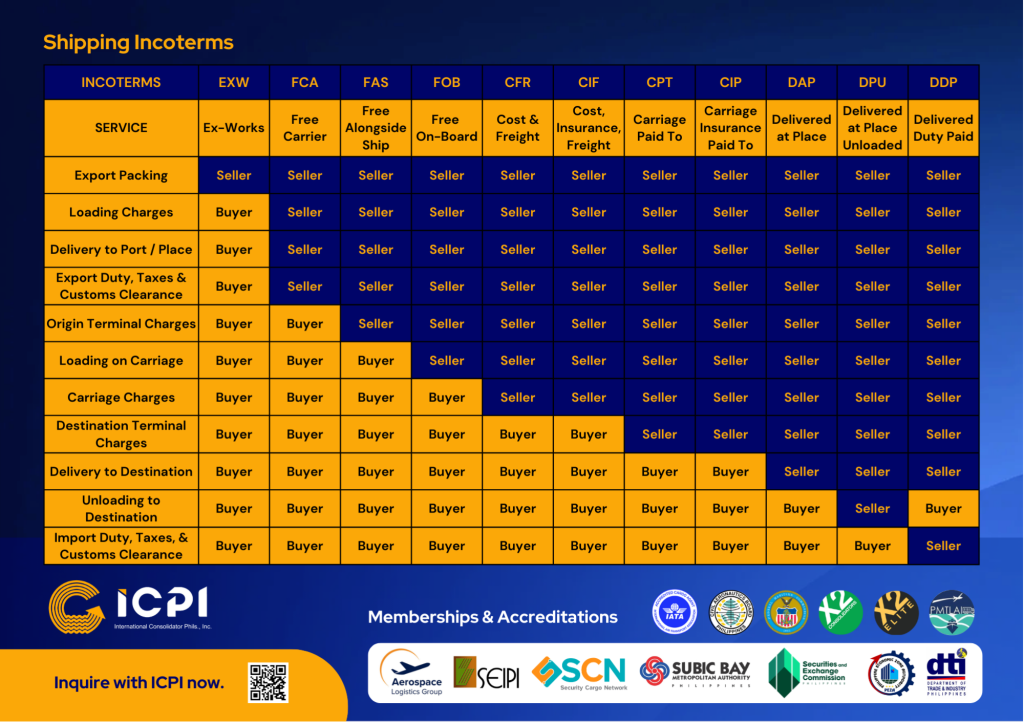
The chart below illustrates the responsibilities of the Buyer and Seller under each Incoterm.
How to Choose the Right Incoterm
Incoterms are more than just shipping abbreviations — they define the financial, operational, and legal responsibilities of international trade transactions.
Choosing the right Incoterm depends on:
- Shipment type
- Cargo type
- Buyer/shipper relationship
- Buyer/shipper internal logistics
- Freight forwarder expertise
- Risk tolerance
For Philippine importers and exporters, understanding Incoterms can help reduce shipping costs, improve logistics planning, and avoid costly misunderstandings.
Whether you are importing industrial equipment, exporting manufactured goods, or managing project cargo, selecting the right Incoterm is a critical part of supply chain success.
Let ICPI guide you on your next shipment.
At ICPI, we understand how valuable your time is, and how easy it is to get lost in the terminologies and processes of global shipments.
Our approach goes beyond freight. ICPI helps your business grow by:
- Strategizing your shipment according to your business needs
- Providing end-to-end freight and brokerage services for your convenience
- Securing competitive and transparent rates, regardless of incoterm
- Guiding you on documentary requirements for efficiency and compliance
- Coordinating with agents and carriers for smooth and worry-free processing
- Updating you throughout every step of the process
With over 32 years of experience in the freight forwarding industry, the ICPI team is equipped to help importers and exporters strategize their shipments and execute them excellently, giving you confidence and peace of mind.
Consult with the ICPI Team today.